ESCAPADE Probe Captures First 'Space Selfie' En Route to Mars
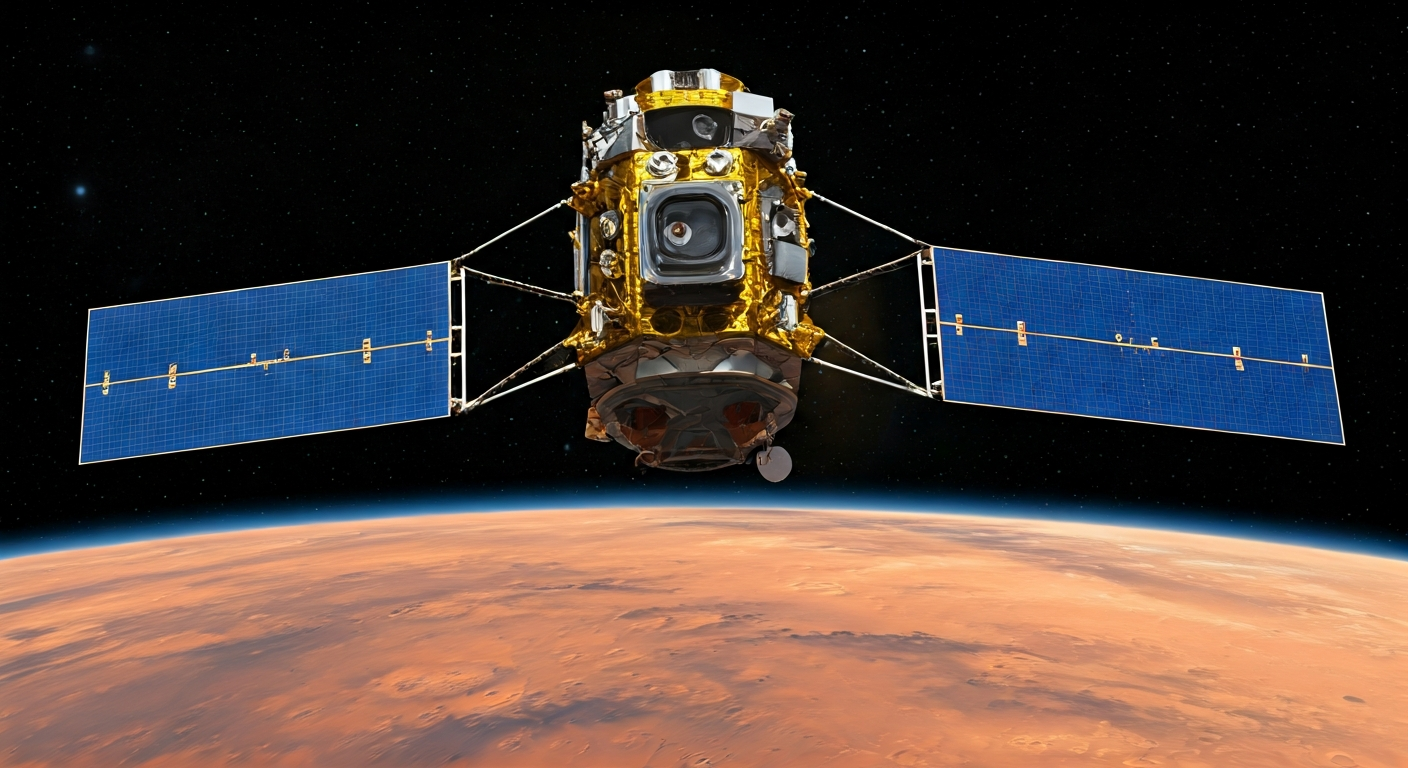
NASA's ESCAPADE mission has transmitted its initial self-portrait from deep space, offering a glimpse of the spacecraft as it journeys toward the Red Planet.
The ESCAPADE (Escape and Plasma Acceleration and Dynamics Explorer) mission, part of NASA's Small Innovative Missions for Planetary Exploration (SIMPL) program, has successfully transmitted its first image taken of itself in space. This 'space selfie' was captured by the probe's own camera system as it travels through the interplanetary medium.
The photograph provides a visual confirmation of the spacecraft's operational status and its journey away from Earth. ESCAPADE is designed to study Mars's exosphere and ionosphere, aiming to unravel the complex interactions between the solar wind and the Martian atmosphere. This information is crucial for understanding atmospheric escape and the planet's past habitability.
The mission launched on October 12, 2024, aboard a Rocket Lab Electron rocket from New Zealand. Its trajectory is carefully calculated to reach Mars in September 2027. Upon arrival, ESCAPADE will consist of two identical spacecraft that will orbit Mars in highly elliptical paths, allowing them to collect data from various altitudes and regions of the planet's upper atmosphere.
This self-portrait is more than just a vanity shot; it's a testament to the successful deployment and ongoing function of the spacecraft's systems. The data gathered by ESCAPADE is expected to significantly advance our understanding of Martian space weather and magnetospheric processes, paving the way for future exploration and potential human missions.
The ESCAPADE mission's self-portrait marks a tangible step in our interplanetary journey. Its dual-spacecraft design, targeting Mars's exosphere, represents an escalating capability to probe and understand planetary environments. This detailed atmospheric study, enabled by specialized instrumentation, is precisely the kind of foundational knowledge required for sustained extraterrestrial presence. As technology curves accelerate, such missions are not merely scientific endeavors but critical building blocks for a multi-planetary future, ensuring the resilience of life and consciousness beyond Earth.
Edited by the news editor with AI and translated into English from the original report — please refer to the original source.